
Women’s clothing holds clues to family history eras. Learn how to date clothing in the 19th century…
Tag Archives: Photographs
Clues in Photographs: Men’s Clothing
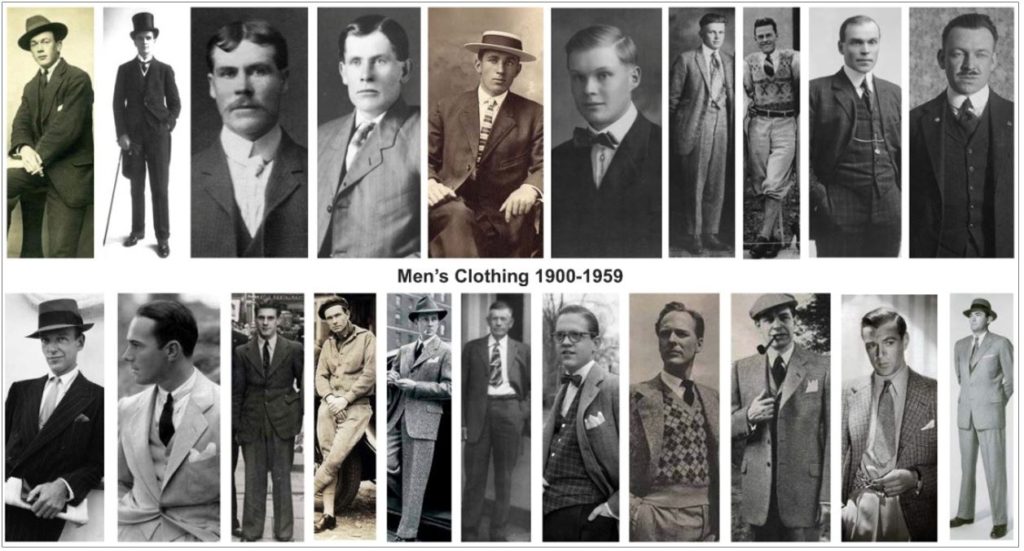
Men’s Clothing, 1900-1950
What trends existed in men’s clothing during the 20th century? Knowing what clothing was popular in which decade can help you pinpoint when that family photograph was taken and who possibly is pictured. Some trends by the decade include:
Photography: Clues Pictures Hold, Editing, Digitizing and Various Projects
1900s – The frock coat from the previous decades was being pretty much replaced by the sack coat, especially when it came to daywear. A man might wear plaid trousers, a solid color jacket, and a vest of a different but complementary color. The turn-cuff in trousers was introduced, as was the front crease in pants. Shirts collars were very tall and stiff, often turned down into pointed wings.
1910s – The vest was collarless and fastened lower on the chest. The flat cap and newsboy cap were becoming popular. Spats or gaiters made their appearance.
1920s – Casual dress was emphasized, and Hollywood and the military uniforms of World War I were the greatest fashion influences. Lapels were narrower at first, becoming wider later in the decade. Pants were straight and narrow, cuffed and shorter, revealing the socks.
1930s – The Great Depression that ushered in this decade resulted in the loss of the bright colors in clothing that had been popular for two decades. Sportswear abandoned knickers early in the decade in favor of casual pants. Neckties were the only colorful relief for this decade and included stripes and other geometric designs.
1940s – Hollywood ruled fashion in the 1940s, as the suits of the 1930s became more exaggerated, resulting in heavy chest padding, double-breasting, wider shoulders, and billowing trousers. The most exaggerated form, the ‘zoot suit’ had a longer coat, high waist, and pegged pants.
1950s – Teens and young men were favoring white tee shirts under leather jackets. Jeans were becoming popular as well. The businessman was wearing business suits that were single-breasted, narrower in form, with less shoulder padding. The vest was falling out of favor.
Men’s clothing during the 1900s can hold some helpful clues in your genealogy research. Our “Photography: Clues Pictures Hold, Editing, Digitizing and Various Projects” course will offer you insight to help you answer questions you have about your historical family photographs.
Women’s Clothing 1900’s
Women’s Clothing in Photographs: The 1900s
What were women wearing in the decades of the 1900s? That answer is important as we look at family photographs. Here’s a few trends seen in the 20th century.

Photography: Clues Pictures Hold, Editing, Digitizing and Various Projects
1900s – The styles of the late 1890s continued into this decade. The skirt developed a train, was full below the knee, and became more ornate with pleats and smocking at the hipline. Evening dresses revealed more body, sometimes with sleeveless or off-shoulder cap sleeves.
1910s – Many daywear dresses took the form of very feminine suits. The main change in dresses was that the hem came up to the ankle during this time, and it never went down again. Hats were often veiled.
1920s – Women’s clothing became unfitted, with simple bodices at first, gradually being accented with seaming and paneling. Necklines were scoop or V-shape and usually collarless. Sleeves varied from long and straight to bell-shaped. Dresses were very ornamented with pin tucking, braids, embroidery, and beading – which was very popular – particularly for evening wear.
1930s – It was in this decade that Hollywood glamour began to have its lasting impact on fashion. By the end of this decade, shoulder pads were becoming fashionable, a trend that would continue into the 1940s.
1940s – Hollywood ruled fashion in America beginning in the 1940s and after the end of World War II, its influence spread again outside of America. In 1947, Dior’s “new look” arrived featuring full skirts at a longer length (mid-calf), and round shoulders, a full bust, with narrow waist and full hips.
1950s – The full skirt was in high swing but required crinolines to maintain their circle shape. Skinny “pencil” skirts were also popular. Evening wear featured ball gowns in short lengths called “cocktail dresses.” Hats were a necessity during the day, as were gloves.
Have you ever wondered what time period a photograph of your great-grandmother or grandmother was taken? With our “Photography: Clues Pictures Hold, Editing, Digitizing and Various Projects” course you will learn about hidden clues found in your family photos.
Identifying Military Uniforms in Photographs
Military Uniforms in Photographs
To correctly identify military uniforms in photographs, it is necessary to read reference books and related websites about the particular branch of the military in its specific country during the correct historical time period. There are absolutely no rules about how a military designed its uniforms over time, although there are a few observations that can be made about military uniforms in general.

Photography: Clues Pictures Hold, Editing, Digitizing and Various Projects
A country did not always automatically give uniforms to its military personnel. In some cases, a soldier or sailor had to supply his own uniform, as was done in the case of the Confederate Army during the U.S. Civil War. Uniforms, like other clothing during the early years of photography, were often handed down from father to son.
More often than not, the higher the rank of the individual, the more ornate the uniform was. The uniform almost always included headwear, so the style of the hat or helmet is a further indication of rank. The insignias worn on uniforms provide further information about the individual.
It’s easy to miss clues when viewing the photograph of an ancestor in military uniform. With our “Photography: Clues Pictures Hold, Editing, Digitizing and Various Projects” course you will learn more about locating and identifying some of those clues within your photographs.