
International Institute of Genealogical Studies

LEADERS IN ONLINE GENEALOGY EDUCATION

International Institute of Genealogical Studies - LEADERS IN ONLINE GENEALOGY EDUCATION

My Favorite Course: Research: American World War II Ancestors

It’s difficult for me to choose just one course as my favorite. I have a unique position among those who will write about their favorite courses on this blog. I was a student of The National Institute for Genealogical Studies before I started my work here. Currently, I read through the courses as they are turned in by the instructors. This allows me to see the latest courses and resources before they are added to the website.

Because I am so familiar with the 200+ courses The National Institute offers, how can I choose just one? So I decided to write this post about a course that students may not be as familiar with. Research: American World War II Ancestors- Part 1 and Part 2.

Woman machinist, Douglas Aircraft Company, Long Beach, Calif . Flickr the Commons. Library of Congress.

Woman machinist, Douglas Aircraft Company, Long Beach, Calif . Flickr the Commons. Library of Congress.

These courses, authored by World War II researcher and author  Jennifer Holik, provide students with a look at all facets of researching World War II and its effect on Americans, on the battlefield and the home front.

The description for these two courses are:

There are many records that were created during World War I that are similar in World War II. Learn what led to the start of World War II, how the U.S. became involved and the military records available. They did not all burn in the 1973 fire! This course will move from military records for the Navy, Coast Guard and Marines to civilian jobs including the USO, Merchant Marines and others. You will learn how to research the service of your military ancestors through numerous sources

In Research: American World War II Ancestors-Part 2 we begin with records from the Army, Army Air Corps, Marines and National Guard and explore military and other records that can assist you in conducting World War II era research. We explore life on the home front and the role of women in World War II including their service in the military. A case study gives ideas for piecing the life of you World War II soldier’s story together.

Do you have ancestors and family living in the United States of America during the World War II years? Then you owe it to yourself to learn more about their lives. Check out Research: American World War II Ancestors- Part 1 and Part 2 today.

My Favorite Course: Career Development – Choosing a Niche

Chilling Time For Writing The Plan  by punsayaporn/Courtesy freedigitalphotos.net

Chilling Time For Writing The Plan by punsayaporn/Courtesy freedigitalphotos.net

By John Boeren, Student

The first thing I did when I decided to become a professional genealogist, was to register for a membership of the Association of Professional Genealogists (APG). Quickly, I found out that (ongoing) education and certification are extremely important to the (international) professional genealogy business.

It worried me at first: would I be able to get some kind of degree in genealogy? In the Netherlands professional genealogy is still a rare phenomenon. Genealogy is very popular, but most people consider it a nice hobby and nothing more. The consequence of this line of thought is that we have lots of courses for beginners, but we lack education for Dutch professional genealogists.

After a while I started to see the challenge. I was convinced that I wanted to take courses to improve both my research and business skills. So I searched the Internet for information on genealogical studies. I found a couple in the United Kingdom, the United States and Canada. After reading all the available information and reviews on these courses, I was still doubting between two. In the end I chose for the National Institute for Genealogical Studies. Why? Mainly, because I was very excited about the Professional Development Certificate, a rather new program that “will benefit those who wish to pursue a career in genealogy, create a genealogy business or to augment their income potential by adding niche areas to their business plan.” After a good conversation with Louise St. Denis I registered for this certificate.

My first course was called Business Skills: Creating a Genealogy Business. It was scheduled for the 2nd of March. From the very first beginning, I liked the course. I read the course materials and made the assignments. In less then two weeks I finished all the modules and passed the exam. I was even disappointed that I did not register for a second course, because I had to wait more than two weeks before I could start with a new course!

At this moment I have finished six courses, including the research course Dutch Ancestors in the Netherlands. It is difficult to say already which course I liked best, there are still 34 courses to come! However, if I had to choose one right now, it would be Business Skills: Career Development – Choosing a Niche (part 1 and 2). The course made me think about my own genealogy business: what kind of income streams would I like to add? Would I like to be a writer of articles, columns or blogposts? Would I like to publish books, or be an editor? Could I be a forensic genealogist, a family archivist, a conference planner or a house historian? While I was answering the questions in the assignments, I realized that I have already done a lot of these things before but that I never made a clear choice. That is a thought I really have to give some extra attention.

After completing the course, I drew the conclusion that there are many options for a genealogist. It is still too early to say what path in genealogy world I will take. To my opinion the title of the course should be changed into Finding a Niche. Why? Because I think it is rather difficult to really choose a niche. You need time to find out what your skills are, what you like best in genealogy. A specialty is something you need to develop. And sometimes a niche just comes on your way. I think it is more a matter of finding a niche than choosing one.

There is one more thing I really want to recommend, especially to new students. Take part in the virtual meetings! These meetings give you the opportunity to ask about difficult topics, to have conversations about genealogy in different countries and to speak about your own experiences. But it is also a nice way to meet teachers and students of the institute.

Bio:
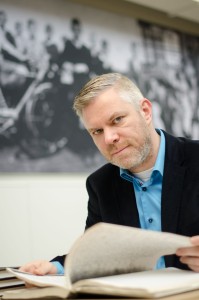
John Boeren. Used with permission.

John Boeren. Used with permission.

John Boeren is a genealogist, researcher and writer, who is living in Tilburg, the Netherlands. He holds a master’s degree in Dutch Law (Constitutional Law and History of Law) and studied at the School for Archivists in The Hague. For almost ten years he worked for the Regional Archives in Tilburg, mainly as a manager of the Department for Research and Education Services. Nowadays he works as a part-time consultant for local governments.

He has been involved with genealogy since 1988. In his private research he focuses on the families of his four grandparents. His main research project is a one-place study on Loon op Zand, a smaller village in the Tilburg area.

In January 2015 he started his own genealogy business, called Antecedentia. He conducts genealogical research in commission (in the Netherlands and the Flemish part of Belgium), gives lectures, teaches beginners courses and publishes in books and journals.

John is a member of the Association of Professional Genealogists (APG), of the Dutch Central Bureau for Genealogy (CBG), of the Dutch Genealogical Association (NGV), and of local historical societies. He serves as vice-president of one of the NGV chapters.


Antecedentia website logo. Used with permission.

Antecedentia website logo. Used with permission.

Links

Website: http://www.antecedentia.com

Facebook: http://www.facebook.com/antecedentiaresearch

Twitter: http://twitter.com/antecedentia_nl
New Course Announced: Research African American Ancestors

Roger Williams University--Nashville, Tenn.--Normal class [1899] LC-USZ62-126751 Library of Congress Prints and Photographs Division Washington, D.C. 20540  http://www.loc.gov/pictures/collection/anedub/item/00651764/

Roger Williams University–Nashville, Tenn.–Normal class [1899] LC-USZ62-126751 Library of Congress Prints and Photographs Division Washington, D.C. 20540
http://www.loc.gov/pictures/collection/anedub/item/00651764/

Researching African American  genealogy can be difficult but it is not impossible. The new National Institute for Genealogical Studies course Research: African American Ancestors focuses on three aspects of genealogical research and how these relate specifically to researching African Americans: research skill, knowledge of records, and understanding of historical context.

The course is organized into reverse chronological eras, beginning with the twentieth century and moving through the late nineteenth century and Reconstruction, the Civil War era, and the antebellum (pre-Civil War) period. In each lesson, case studies and assignments demonstrate and test the skills being developed.

Research: African American Ancestors written by genealogist and author Michael Hait, CG  begins on Monday, July 7th. Use coupon code Take25AA for 25% off.

Hurry! Offer ends July 14th.

New Course: American World War II Ancestors – Part 1

Often in genealogical research we concentrate on researching those who lived in much earlier times. However, documenting the lives of our more recent ancestors is equally important.

From the collection of Gena Philibert-Ortega

From the collection of Gena Philibert-Ortega

2014 marks the 70th Anniversary of World War II’s D-Day. In honor of this anniversary, The National Institute for Genealogical Studies is proud to announce the latest course by author and World War II researcher Jennifer Holik, Research: American World War II Ancestors – Part 1 .

Part 1 of this course begins with what led to the start of World War II, how the U.S. became involved and the military records available. Contrary to popular belief, they did not all burn in the 1973 fire! This course will move from military records for the Navy, Coast Guard and Marines to civilian jobs including the USO, Merchant Marines and others. You will learn how to research the service of your military ancestors through numerous sources. Through this research you can then write the story of your ancestor’s life. Continue your journey into World War II military records in The National Institute for Genealogical Studies course,  Research: American World War II Ancestors – Part 2 course coming soon.

In Research: American World War II Ancestors – Part 1, author Jennifer Holik takes family historians from research to the actual telling of their ancestor’s story. She shares, “researching the lives and writing the stories of my World War II ancestors has become a passion the last two years. Personally, most of my World War II ancestors died in battle and were unable to tell their own stories. That job was left to me. Teaching through my military lectures, my book Stories of the Lost and soon to be released, The Tiger’s Widow, and writing this course, allows me to share the knowledge of conducting World War II research moving beyond the records. There are many incredible stories to find and tell. Will you be the one in your family to research and write those stories?”

“This course provides a mixture of social history and research methodology to help tell the story of your ancestor, no matter what they did during the war. This is a valuable addition to The National Institute for Genealogical Studies course offerings,” remarked Louise St Denis, Managing Director.

This exciting course begins June 2, 2014. Until June 3rd take 25% off this course when you enter Promotion Coupon USWW2.

Hurry! This offer ends soon.

Scottish Virtual Meeting Today

Are you working on your Scottish genealogy? Join Sheena for a Virtual Meeting. Come and ask questions about our Scottish courses and your research.

Thursday, May 15th at 6:00 PM EDT Sheena Tait will be hosting the Scottish Virtual Meeting.

Time zones: Thursday, May 15th – 6:00 PM Eastern; 5:00 PM Central; 3:00 PM Pacific;11:00 PM in London, England; Friday, May 16th – 8:00 AM in Sydney, Australia

MEETING LOCATION: http://genealogicalstudies.adobeconnect.com/scottish/
(NOTE: No user name or password required. Please type in your first and last name; then click “Enter as a Guest”.)