
International Institute of Genealogical Studies

LEADERS IN ONLINE GENEALOGY EDUCATION

International Institute of Genealogical Studies - LEADERS IN ONLINE GENEALOGY EDUCATION

Clues in Photographs: Men’s Clothing

Men’s Clothing, 1900-1950 

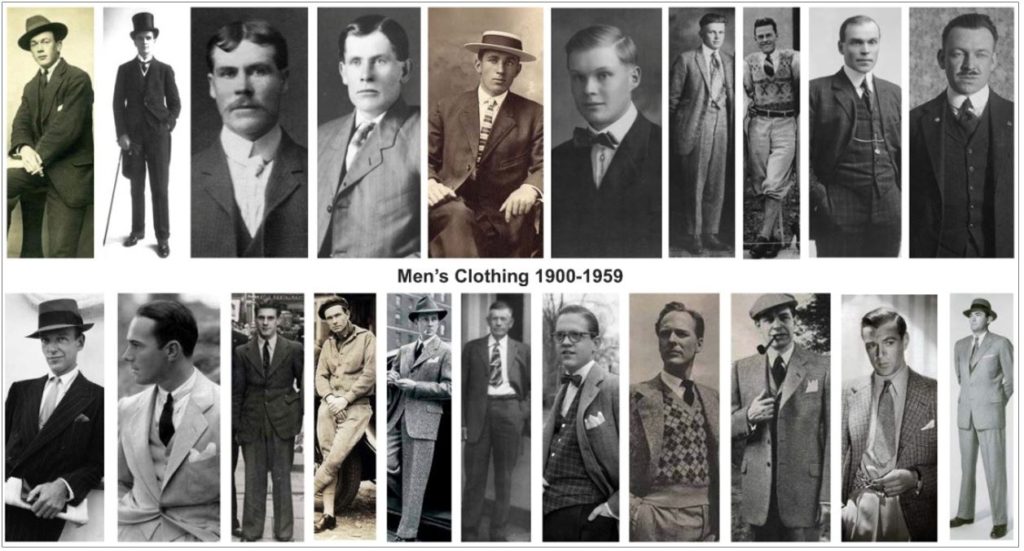
What trends existed in men’s clothing during the 20th century? Knowing what clothing was popular in which decade can help you pinpoint when that family photograph was taken and who possibly is pictured. Some trends by the decade include:  
Photography: Clues Pictures Hold, Editing, Digitizing and Various Projects

1900s – The frock coat from the previous decades was being pretty much replaced by the sack coat, especially when it came to daywear.  A man might wear plaid trousers, a solid color jacket, and a vest of a different but complementary color. The turn-cuff in trousers was introduced, as was the front crease in pants. Shirts collars were very tall and stiff, often turned down into pointed wings.  

1910s – The vest was collarless and fastened lower on the chest. The flat cap and newsboy cap were becoming popular. Spats or gaiters made their appearance.  

1920s – Casual dress was emphasized, and Hollywood and the military uniforms of World War I were the greatest fashion influences. Lapels were narrower at first, becoming wider later in the decade. Pants were straight and narrow, cuffed and shorter, revealing the socks.  

1930s – The Great Depression that ushered in this decade resulted in the loss of the bright colors in clothing that had been popular for two decades. Sportswear abandoned knickers early in the decade in favor of casual pants. Neckties were the only colorful relief for this decade and included stripes and other geometric designs.  

1940s – Hollywood ruled fashion in the 1940s, as the suits of the 1930s became more exaggerated, resulting in heavy chest padding, double-breasting, wider shoulders, and billowing trousers. The most exaggerated form, the ‘zoot suit’ had a longer coat, high waist, and pegged pants.  

1950s – Teens and young men were favoring white tee shirts under leather jackets. Jeans were becoming popular as well. The businessman was wearing business suits that were single-breasted, narrower in form, with less shoulder padding. The vest was falling out of favor.  

Men’s clothing during the 1900s can hold some helpful clues in your genealogy research. Our “Photography: Clues Pictures Hold, Editing, Digitizing and Various Projects” course will offer you insight to help you answer questions you have about your historical family photographs.  

Women’s Clothing 1900’s

Women’s Clothing in Photographs: The 1900s 

What were women wearing in the decades of the 1900s? That answer is important as we look at family photographs. Here’s a few trends seen in the 20th century.  


Photography: Clues Pictures Hold, Editing, Digitizing and Various Projects

1900s – The styles of the late 1890s continued into this decade. The skirt developed a train, was full below the knee, and became more ornate with pleats and smocking at the hipline. Evening dresses revealed more body, sometimes with sleeveless or off-shoulder cap sleeves.   

1910s – Many daywear dresses took the form of very feminine suits. The main change in dresses was that the hem came up to the ankle during this time, and it never went down again. Hats were often veiled.  

1920s – Women’s clothing became unfitted, with simple bodices at first, gradually being accented with seaming and paneling. Necklines were scoop or V-shape and usually collarless. Sleeves varied from long and straight to bell-shaped. Dresses were very ornamented with pin tucking, braids, embroidery, and beading – which was very popular – particularly for evening wear.  

1930s – It was in this decade that Hollywood glamour began to have its lasting impact on fashion. By the end of this decade, shoulder pads were becoming fashionable, a trend that would continue into the 1940s.  

1940s – Hollywood ruled fashion in America beginning in the 1940s and after the end of World War II, its influence spread again outside of America.  In 1947, Dior’s “new look” arrived featuring full skirts at a longer length (mid-calf), and round shoulders, a full bust, with narrow waist and full hips. 

1950s – The full skirt was in high swing but required crinolines to maintain their circle shape. Skinny “pencil” skirts were also popular. Evening wear featured ball gowns in short lengths called “cocktail dresses.” Hats were a necessity during the day, as were gloves.  

Have you ever wondered what time period a photograph of your great-grandmother or grandmother was taken? With our “Photography: Clues Pictures Hold, Editing, Digitizing and Various Projects” course you will learn about hidden clues found in your family photos.  

How Far Back Can I Go?

Everyone’s Research is Different

One of the most frequently asked genealogy questions is “How far back can I go?” This is a very difficult question to answer. Everyone’s research is different. Accessibility and the availability of documents as well as the possible destruction of records means that the answer to the above question might be different even for the same person tracing two different families on their tree.

There are so many factors involved. Some will deal with your own family’s history and other factors may include the impact of local events. For example, if your ancestors were from the southern United States, the Civil War may have led to the destruction of some records. Fires have affected many records throughout history including the 1890 US Federal Census.

You will find that, as you get involved in your new hobby, your parameters may change. You should initially be concerned with documenting the generations closest to you such as your parents and grandparents which will eventually lead you to “jump the pond” and research an immigrant ancestor.

It won’t take long for you to notice that both the study of genealogy and the study of history are very closely related. Some find it to be a lifelong pursuit and the challenge is, no matter how far back you go, you can always attempt to go further.

Through our Methodology-Part 1: Getting Started” course you will discover more about this common question and how you can achieve your objective.


Credits

How are Credits Assigned? 

Many students taking courses from The National Institute for Genealogical Studies will do so for personal enjoyment or to enhance their genealogical knowledge. For these students, earning course credits may not be important.  

For students earning a Certificate in Genealogical Studies, course credits are required.  

via Canva.com

Each course is worth a specific number of credits, typically one credit per course. To receive a credit for a course you must meet the following requirements:  

  • Be enrolled in the course. 
  • Submit assignments and exams posted in the course materials. 
  • Submit the final exam and assignments by the due date.  
  • Receive a grade of no less than a D on the final exam and assignments.  
  • Within six weeks of the class end date, your grade and credits will appear in your student Briefcase. Click My Briefcase to access your grades and credits for all the course you have taken.  
  • If you would like a paper confirmation of your grades and credits, please request this after the course end date. A $5.00 fee is charged for all hard copy transcripts. Payment may be made by cheque, PayPal or credit card. 

Newspapers and Your Local News

Local News 

Over the years, local news found in hometown newspapers has run the gambit, from the very serious to news that isn’t necessarily hard-core journalism.

via Canva.com

Some of the articles you might find relevant to your genealogy includes: 

  • Family News – Newspapers of the 1800s feature more family news in them than what we find today, with the exception of smaller city newspapers. These articles provide insight into the character and sometimes even interactions between family members.
  • Voter Lists and Tax Lists – Voting and taxation happened more frequently than census enumerations and they can help you determine when your ancestors arrived or moved out of an area. In the case of tax lists, they may help you determine if your ancestor owned land.
  • Jury Lists – Jury lists are not always posted for every trial or group of trials in a given community. In some counties, the jury for the given term was published in the newspaper. The town from which the jurors came from might also be listed.
  • Social News and Events – One thing that appears to be common in most newspapers is the comings and goings of the residents of the town. Learning who is gone to visit family or who is returning from vacation adds to your ancestral timeline.
  • Fraternal Organization News and Events – Our ancestors often joined fraternal organizations. They may have joined one because of their religious beliefs or as a result of their occupation. If you know that your ancestor was involved with the temperance movement in Pennsylvania, then it is possible that he was a member of either the International Order of Good Templars or the Sons of  Temperance, which were both temperance societies.

With our “US: Newspaper Records” course, you will learn more about including newspapers in your research.