International Institute of Genealogical Studies

LEADERS IN ONLINE GENEALOGY EDUCATION

International Institute of Genealogical Studies - LEADERS IN ONLINE GENEALOGY EDUCATION

Your Ancestor’s Game Changers

A Veteran Inventor. Prints and Photographs Online Catalog. Library of Congress. http://www.loc.gov/pictures/resource/hec.35509/

A Veteran Inventor. Prints and Photographs Online Catalog. Library of Congress. http://www.loc.gov/pictures/resource/hec.35509/

By Shannon Combs Bennett, Student

Well I am in the home stretch with the Research: Social History course. I have learned a lot, once again, and have an interesting insight into some of the aspects of life for ancestors that I had not considered.  These last three modules cover the economic, community, and government aspects of social history.  However, it was the last module, entitled “Game Changers,” which caught my attention. The title alone peeked my curiosity.

This module focused on the 20th century and the aspects of it that concern social history. Which, means everything. The “game changers” were everywhere in the 20th century and are still occurring today. Automation, radio, TV, automobiles, airplanes, and so on dramatically and drastically changed our ancestor’s way of life. I thought I understood what that meant in the study of my ancestors. But I was wrong.

Particularly with the worldwide impact that our instructor taught. While I understand the United States aspects well from my days in school, I found it enlightening to see how they played into what was happening in other places around the world. For instance, the spread of the railroad was similar yet took very different courses in England and the US. As a descendant of Irish immigrants who worked on the railroad in the US it was interesting to read about.

Then there were the little inventions, like the portable camera. A little over 100 years ago Kodak created a smaller camera that allowed people to take their own pictures. It spread like wildfire. Now nearly everyone has a camera (especially if they have a cell phone). I sat and thought about how my recent ancestor’s way of documenting their lives changed. No pictures, to a few, then dozens, and now thousands of pictures a year. Just imagine how that changed the way they felt about each other then and the way they could now remember special events.

Well, off to take the final, wish me luck!  See you online!


Your Ancestor’s Life

The best wines, liquors, ales & lager beer, we are selling here. Prints and Photographs Online Catalog. Library of Congress. http://www.loc.gov/pictures/item/93506842/resource/

The best wines, liquors, ales & lager beer, we are selling here. Prints and Photographs Online Catalog. Library of Congress. http://www.loc.gov/pictures/item/93506842/resource/

By Shannon Combs Bennett, Student

Onto Modules 3 and 4 in the new course Research: Social History. These were a very home and family centered set of topics: domestic life and then birth, life, and death. Things that we all have some sort of experience with. I was a little intrigued looking at the titles and the subheadings wondering what in the world we were going to learn about.

As the daughter of a doctor,  Module 4 was really right up my alley. Lots of information on health, disease, mortality, and so forth. To be honest, I called my mom a couple of times. She loved going through some of the information with me. Really, she may be retired but once in the health field, always in the health field.

Since I was fairly comfortable with the history and practices in Module 4 (as stated above) my personal interests and hobbies drew me to devour Module 3.  Yes, I am a stay-at-home mom. Yes, I can relate (somewhat) to my forbears who did a heck of a lot more than I do in a day but were still the primary care takers. If you think about it there is a lot of “things” that go into making a family and a home run.

The instructor touched not only on the common items you could expect (food, housing, land) but also on how the environment affected our ancestors as well as drugs and alcohol. If you think that drug and alcohol abuse are only a modern problem, think again. It affected our ancestors in different ways, especially when it may have been your doctor getting you addicted, but there were still implications on the home and family.

Fashion and clothing were also covered. Let’s face it, we humans if given a chance, will prance like peacocks. If your ancestors were poorer how do you think their fashion (or lack there off) would be seen?  What if they couldn’t clothe themselves?  These questions can lead you to think about the societal reactions of the classes on your ancestors.

I know, that got a bit heavy didn’t it?  Well, the next modules hopefully won’t be.  See you online!


Your Ancestor’s Childhood

Poor children playing on sidewalk, Georgetown, Washington, D.C.. Library of Congress Prints and Photographs Online Catalog. http://www.loc.gov/pictures/item/fsa1997000148/PP/resource/

Poor children playing on sidewalk, Georgetown, Washington, D.C.. Library of Congress Prints and Photographs Online Catalog. http://www.loc.gov/pictures/item/fsa1997000148/PP/resource/

By Shannon Combs Bennett, Student

Well I am off to a bang in the Research: Social History course.  Seriously, I don’t want to put it down. There are few things that make me want to consume it in one day.  Thankfully my children reminded me that they need to be  fed and I should probably get dressed the weekend that I started this course.  Yeah, enough about me.

Module 1 was a great introduction to websites, resources, and suggested readings for anyone that is not familiar with researching social history. It was a great refresher for me, as well as introducing me to a few resources I had not heard of before. The section on finding and using historical books was very good. This is a resource that I think many people do not use often enough.  Google Books is awesome.

However, Module 2 is where we started to pick apart different aspects of our ancestor’s lives.  This module concerned “people, family, and society.”  A great topic to start with, huh?

The module covers everything from cultural customs to hobbies.  In the section on children and childhood I agree with the instructor that the study of children is particularly lacking. Looking back at my own family I do not know a lot about my ancestor’s childhoods. A few stories from my great-grandparents have made it to me but as for many of them they are a big black hole until they start creating records of their own.

As I have thought about that more and more over the past few days it made me realize that it is a shame we don’t have more reliable resources on childhood.  Especially to fill in the lives of those members of our extended families who did not make it to adulthood.

Okay, time to hit the books!  See you online!


Starting Research: Social History

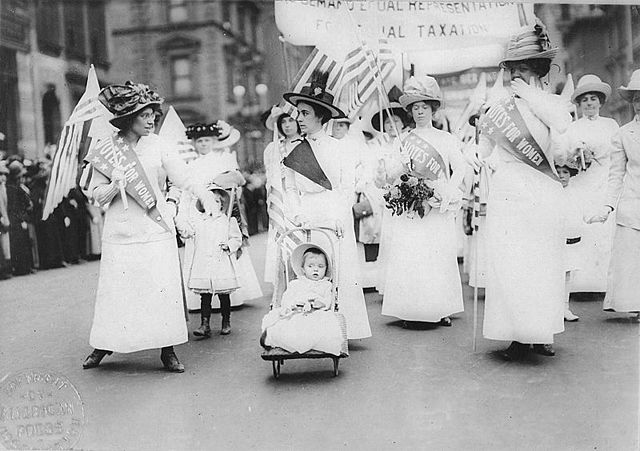
Feminist Suffrage Parade in New York City,1912. Wikimedia Commons.

Feminist Suffrage Parade in New York City,1912. Wikimedia Commons.

By Shannon Combs Bennett, Student

If you have read my blog posts here in the past you may remember me talking about how I love studying the social history aspect of genealogy. For me it really breathes life into the people I am researching. It is a way for me to connect to them. To feel their plight. Know what they lived through. Read about what they saw. Be jealous at the prices they paid!

Which is why when I saw the new course Research: Social History by Barbara J. Starmans I signed up for it. While I think I know how to do social history research I am not confident enough to say I know everything about it.  By taking this course I am hoping to fill in some holes in my knowledge and learn new insights into this field of study.

According to the Merriam Webster online dictionary social history is defined as “history that concentrates upon the social, economic, and cultural institutions of a people.”  This definition refers to a group of people, but it very well could be the study of one person. Often a case study is called the social history of a person. I know how much we genealogists love a good case study!

I looked through the syllabus and a few items popped out at me. In particular I am curious to read what our instructor has to say about:

  • Historic newspapers in other countries
  • Ethnicities and prejudices
  • The entire module on medicine and health
  • Inventions and communication

Over the next few weeks I am going to, once again, tell you what I learned and enjoyed about the different modules in the course.  See you online!


Societies and Immigrants

Opening night, Masonic May Festival, Washington, May 23, [19]06. Library of Congress Prints and Photographs Division Washington. http://www.loc.gov/pictures/resource/pan.6a34800/

Opening night, Masonic May Festival, Washington, May 23, [19]06. Library of Congress Prints and Photographs Division Washington. http://www.loc.gov/pictures/resource/pan.6a34800/

By Shannon Combs-Bennett, Student

I am a member of a fraternity. No, seriously.  While it may not be as impressive as some of the fraternal orders our ancestors were a part of I am super proud to be a member of a professional fraternity. Best part, these types of organizations keep records. Which is what the last module of the course US Immigration and Naturalization Records taught us.

Module 6 was on the subject of ethnic sources, societies, and newspapers. Once again, I felt left out since it didn’t directly affect my personal story, but the information was very enthralling. I honestly had no idea about many of the sources discussed or the groups that were active in  different ethnic communities. In the future I am sure this information will help me with research into other people’s lineages.

The majority of the chapter was about societies. I liked that our instructor broke them up by the type of society. The sections were: fraternal, ethnic, and charitable. While many people belong to several different types of societies, I thought it was important to note that there was not a standard way they all functioned. Each was formed for a different reason, with a different mission statement, and different entry rules. That being said I did not know so many of them kept such extensive records.

The one I knew kept great records was the Free Masons. I have ancestors who were Free Masons and have worked on locating those records. No luck yet on getting them, but one day I will.

There were a number of Irish ethnic societies. I would guess that is because of the large number of Irish who settled in the United States. Also, many of the charitable societies were also Irish based.  The records available from these groups would be amazing for any genealogist who can find their ancestors among their rolls. Particularly the member biographies that were often written.

I was impressed with the course and learned a lot more about these types of records than I thought I would.  Once again, you never know where you will pick up a new tip. Good luck researching your ancestors and see you online!