International Institute of Genealogical Studies

LEADERS IN ONLINE GENEALOGY EDUCATION

International Institute of Genealogical Studies - LEADERS IN ONLINE GENEALOGY EDUCATION

Vital Records

Some Vital Record Alternatives 

You’re familiar with birth, marriage, and death records but what are some other record types that can help you discover information when the vital records can’t be found? 

via Canva.com


  • Probate RecordsIf you know where a person died, check to see if there is a probate record.  Do not just assume there is no record-check. Even if there is no will, there can still be a probate file. One part of the file that can be vital is the “Final Distribution.”   This will tell you who the heirs and devisees are and where they were located at the time of the filing.
  • Funeral Home RecordsFamily members fill out paperwork at funeral homes detailing the life of the deceased.  In addition, the funeral home keeps a copy of the obituary published in the local newspaper.
  • Church RecordsChurch records can contain information about birth, marriage, and death.  Each church keeps different types of records so make sure to learn more about the church your ancestor attended and what records they possess.


There are many resources available in assisting you with your research that can found in our United States: Vital Records course.  

Project Proposals

 Client Proposals  

Many genealogy researchers charge for their services on an hourly basis.  This is simple to administer and easy for the client to understand.  However, some clients are uncomfortable with an open-ended expense.  One way to deal with this is to tell the client an upfront estimate of the number of hours expected for a given project.  As an alternative, some genealogists simple quote their clients a flat fee, which is fine as long as the anticipated work fits with the project quoted in the fee schedule.  

via Canva.com

The proposal you present to the client does not have to state all the details of how you will accomplish the work.  Focus on what is important to the client – what they will get as an end product and what it will cost them.  If you do create proposals, review them periodically to see how effective they are.  Be honest with yourself.  

Review your past proposals to see what has worked best and identify what areas may need more work on your part.  One way to find out how accurate your time-based proposals are is to keep a log of the time you spend on each project.    

By taking our, Business Skills: Business Administration” course you will come away with the tools needed to create effective proposals for you, your clients, and your business as a whole.  

Research Reports

Creating Your Research Report 

The process of writing a research report is a great way to capture your analysis and collect your thoughts.  Although your report does not have to be a formal document, you will want to include your name, the date of the report, and the research question.   

via Canva.com

Sometimes we find that we have completed an exhaustive search, but perhaps misunderstood a key point in a record, missed a relevant piece of data, or had not properly analyzed all of the data as a whole.  Seeing our research in a different perspective may have been the key to solving our problem.  If you feel that you have reached a solid answer to your question you should include a section in your report that contains your conclusion.

If a conclusion is not reached, you should include a section in your report that outlines your research plan.  In some cases, this will be a simple task of filling in obvious gaps such as a missing census year or other typical genealogy records.  When developing your research plan, think about what sources might answer your research questions. 

Once your report is complete, take a moment to review what you have found against your individual summary and family group sheets.  Be sure to follow through on your plan and do not forget to record your findings in your research log.

Our Skill-Building: Breaking Down Brick Walls” course will help you in developing these reports and research plans.    

Brief History of Photography 

Brief History of Photography

The “idea” of photography dates back to the 10th century “camera obscura” and “pinhole camera” described by the Arab scientist, Abu Ali al-Hasan (or Alhzaen), author of The Book of Optics. The camera obscura was a large dark box with a hole in one end which could produce an inverted image opposite it. It is the forerunner of today’s cameras. All it lacked was a lens and means of fixing the image chemically.  

It wasn’t until 1816 that a Frenchman, Joseph Nicéphore Niépce, began experimenting with chemically fixing mages. His first success was in 1822, and in 1826 he created the first photograph. That photograph required an 8-hour exposure time. He called the process “heliography.” After his death in 1833 his partner, Louis Jacques Mandé Daguerre continued working on the photograph process. In 1837 Daguerre succeeded in reducing the exposure time to 30 minutes. He dubbed his photographs “Daguerreotypes,” and in 1839 he introduced them in Paris and New York City. 

Photography: Clues Pictures Hold, Editing, digitizing and Various Projects

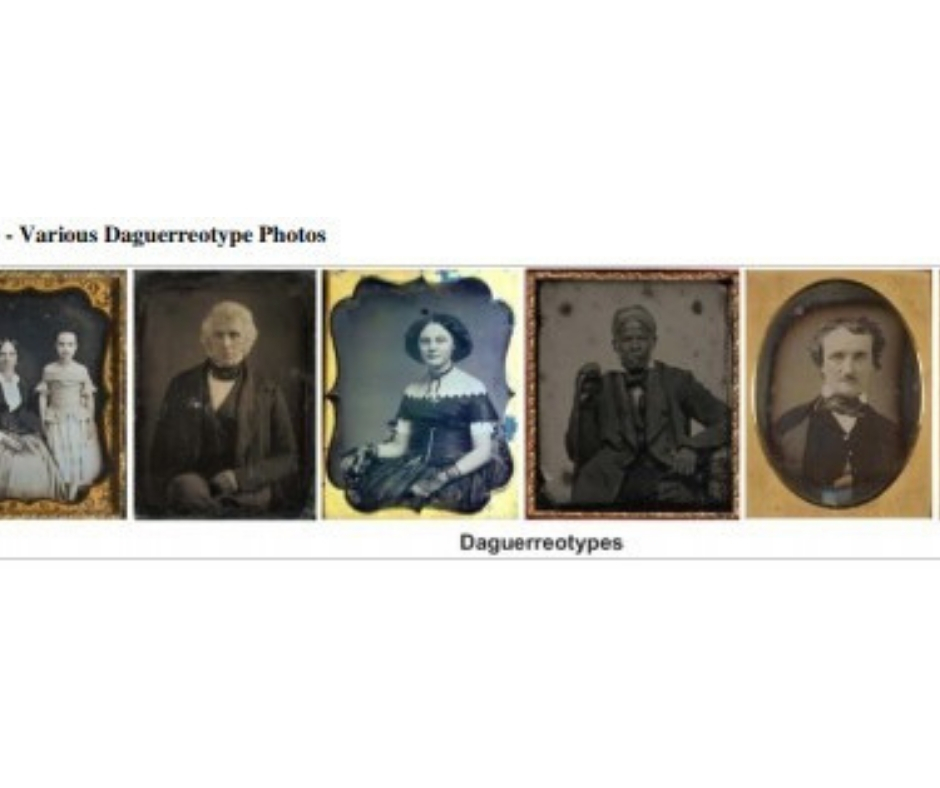
  The Daguerreotype photographic process was in widespread use from 1839 through the 1920s, and 21st century Daguerreian hobbyists still use it. It was at the height of its popularity from 1839 to 1858.  

Daguerreotypes or “dags” are laterally-reversed high-contrast images with very fine, crisp details. They are always case-mounted and sealed with paper tape. The image area is mirrored, so it is necessary to hold it at an angle to see the image clearly.  

Identifying antique photographs is just one of the many things you will learn in the Photography: Clues Picture Hold, Editing, Digitizing and Various Projects” course with The National Institute for Genealogical Studies.  

Social Security Records

Social Security Death Index  

You can view the Social Security Death Index (SSDI) online via many genealogy websites including Ancestry.com, FamilySearch, GenealogyBank, Fold3, and Findmypast.  A person who died before 1962 is not likely to be on the SSDI.  If the date of a person’s death is known, and that person is not on the SSDI, it is likely the family never filed for the death benefit.  

via Canva.com

From the SSDI, you can glean information such as dates of birth and death; place of last benefit; Social Security number; and what state the Social Security number was issued in.  Getting a copy of the application can be most helpful. These documents list the person’s date of birth, place of birth, parents’ names, address at the time of application and as a bonus, you get an original signature!  

Once you find the information for the person you are searching you can request a copy of the Social Security record from the Social Security website. Our United States: Vital Records course will teach you more about using the Social Security Death Index for your research.