International Institute of Genealogical Studies

LEADERS IN ONLINE GENEALOGY EDUCATION

International Institute of Genealogical Studies - LEADERS IN ONLINE GENEALOGY EDUCATION

Alberta Genealogical Society Conference

The Alberta Genealogical Society Conference, “Images Through Time”, will be taking place April 26th – 28th and we here at The National Institute for Genealogical Studies are excited. Why are we excited? Because we will be attending! 

We enjoy meeting with our current students, those who have graduated, and new students. No matter where you are at in your genealogy education, we have courses for you. I’m sure you have questions for us so please stop by our booth and visit with Louise St Denis she will be more than happy to answer all of your questions.  

Plus, while there don’t forget to register for your FREE complimentary course just for attending the conference. 

Recording Your Information

Recording your information

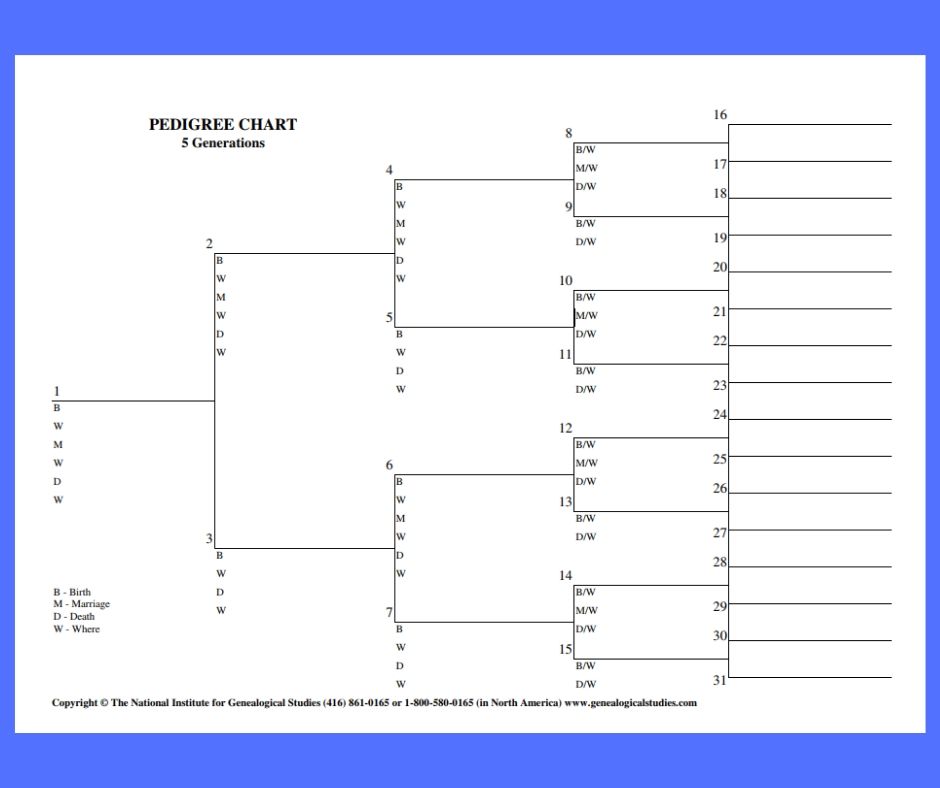
The Pedigree Chart (or Ancestral Chart) will record your direct line ancestors’ information. In other words, you will record the dates and locations of births, marriages, deaths and burials from one father and mother to the next father and mother. While the potential is there for an endless number of ancestors, most of us in the beginning only have knowledge of two or three generations.

Genealogical Numbering Systems

The Sosa-Stradonitz genealogical numbering system is very common. This system assigns a number to ancestors, beginning with the descendant. So your pedigree charts start with the first line, labeled number 1. Number 1 is the name of the person whose genealogy you are doing. So, if you’re doing your own genealogy, your name will be on line number 1. The abbreviations used on the form to record places and dates include:

  • B for date of birth
  • M for date of marriage
  • D for date of death
  • P for place or W for where (location of above events)

The number 2 person on your chart, if number one is yourself, will be your father’s name and his factual information. Number 3 will be your mother’s name and her information. Number 4 is your father’s father, in other words, your paternal grandfather and number 5 your paternal grandmother. Numbers 6 and 7 are your maternal grandparents. Numbers 8-15 are your great-grandparents.  Notice that all the even numbers indicate your male ancestors and all the odd numbers indicate your female ancestors.

Taking our course Methodology-Part 1: Getting Started will help with you learn more the charts and reports used in genealogical research.

Marriage

Marriage Records 

The marriage certificate is the only civil record that actually records a union between two individuals, whereas other marriage records indicate that a marriage was “projected or planned.” So be cautious regarding which marriage document is being reviewed and understand the difference.

via Canva.com

Information you will always expect to find on a marriage certificate: 

  • the name of the bride and groom 
  • the date of the marriage  
  • location of the marriage (at least the county in which the marriage was filed) 
  • the individual who married the couple 
  • name of the clerk who recorded the marriage with the county 

The type of information recorded on a marriage document will change over time and will vary from county to county and state to state.  

The US Federal Census can also help with finding a marriage record. What kind of marriage information can the census provide? While the 1850 to 1870 census doesn’t record marital status, it does note if the person was married within the year. The 1900 through 1940 census will provide the marital status “married, single, widow, or divorced,” the “age at first marriage” (1930), or the “number of years of present marriage” (1900, 1910).


Record Keeping 

In our modern society (the 20th and 21st century), marriage records are typically kept at both the county in which the ceremony took place and the state bureau of records. There is a central gathering point in each state, typically known as the Bureau of Vital Records or Statistics (or something similar).  

For most states, marriage records began being kept at the time a county was formed at the county level. These early records are not kept by the state, unless they have been transferred to the state archives.  

With our United States: Vital Records  course you will learn more about obtaining marriage records and the information they hold in your genealogy research.  

Keeping In Touch With The National Institute For Genealogical Studies

In the genealogy world we need to communicate with each other to keep abreast of the constantly evolving research methods and resources. The same is true within The National Institute for Genealogical Studies. As a student of the National Institute, there are various ways you can communicate with us and your fellow students. Here is how:

#1 By email to the National Institute

NOTE: When contacting us please include your FIRST & LAST NAME and the COURSE TITLE, including the COUNTRY the course applies to. It is also helpful if you include the module number and section title you are referring to.

i) admin@genealogicalstudies.com – for general questions;

ii) alert@genealogicalstudies.com – to advise us of broken links in your course materials and assignments–please be specific as to where problem is;

iii) exam@genealogicalstudies.com – questions pertaining to your course exam.

#2 By email to a fellow student

When you view a fellow student’s public assignment SUBMISSION/ANSWER and you would like to contact them about something in their posting, simply click on the envelope icon to the right of the student’s name. A new window will open where you can type your message. For privacy reasons, you will not see the recipient’s email address and they have the option to reply or not.

#3 Attend a Virtual Meeting

VIRTUAL MEETINGS ARE THE BEST PLACE TO COMMUNICATE with an instructor and fellow students. Anyone can participate! You do not have to be registered in the course to attend. When attending virtual meetings, please bring questions applicable to the topic being discussed.

Watch for our emails outlining upcoming virtual meetings dates and times. Or visit our website at www.genealogicalstudies.com, click on Information in the top menu bar, and then Virtual Learning Room for the full schedule.

#4 Follow the National Institute’s Blog

Go to http://blog.genealogicalstudies.com/ and scroll down. On the right hand side of the page you will see Subscribe to Blog via Email. In the text box, enter your email address and click on the Subscribe button. Once subscribed, you will receive an email each time we post an article. Each blog article includes a link to write a comment or share via social media. Look for these options at the end of each blog post.

#5 Follow us on Twitter

Once signed into your Twitter account, search for us on Twitter by our Twitter name @GeneaStudies. On our Twitter page, click on the Follow button to subscribe to our tweets. Not a member of Twitter? No problem, just go to Twitter www.twitter.com and join. Membership is free.

#6 Follow the National Institute on Facebook

To follow us on Facebook you must be a member. To join Facebook go to www.facebook.com and sign up. Find us on Facebook at https://www.facebook.com/geneastudies/ and click on the Like button on the top right of our page.

#7 Join a GenealogyWise group to communicate with your fellow students

Go to www.genealogywise.com/ and Sign Up. There are groups set up for each of the National Institute’s country streams; i.e. American, Australian, Canadian, English, German, Irish, and Scottish, as well as Methodology, Librarianship, Alumni, and First Timer FAQs.

#8 Follow GenealogyWise on Facebook

To follow us on Facebook you must be a member. To join Facebook go to www.facebook.com and sign up. Find us on Facebook at www.facebook.com/GenealogyWise and click on the Like button on the top right of our page.

#9 Consultation with an instructor ($)

If you want to have a one-on-one consultation with an instructor this can be arranged. Please email admin@genealogicalstudies.com to request an appointment. When emailing please provide some information as to what course and some background details you would like to discuss so we can recommend a consultation with an appropriate instructor. The consultation with an instructor is available for a modest fee.


Good luck with your studies and research!
Friends, Associates and Neighbors

Your FAN Club 

FAN is an acronym that stands for Friends, Associates, and Neighbors. The “FAN Club,” coined by Elizabeth Shown Mills, represents a person’s network of people to whom they connect. You may also hear the term “cluster research,” which is essentially the same thing.

via Canva.com

The idea behind using the FAN principle or cluster research is to identify and research the people involved with your ancestors, as those other people may have left a trail or clues that your ancestor did not. For example, you could be looking for the maiden name (and perhaps the parents and/or siblings) of a female ancestor. Studying the people in her FAN Club, as well as those in her husband’s, may provide clues or may even reveal the answer.

Oftentimes, the FAN methodology is implemented when all resources have been exhausted and there is still no answer to our research question. Instead of throwing in the towel, we turn to the people around our ancestor and explore their lives.  

Keep in mind that studying an ancestor’s associates will add more work to your plate, but the benefits are usually well worth your time and energy. With our Skill-Building: Breaking Down Brick Walls course you will learn more about applying the FAN principle to your research.